
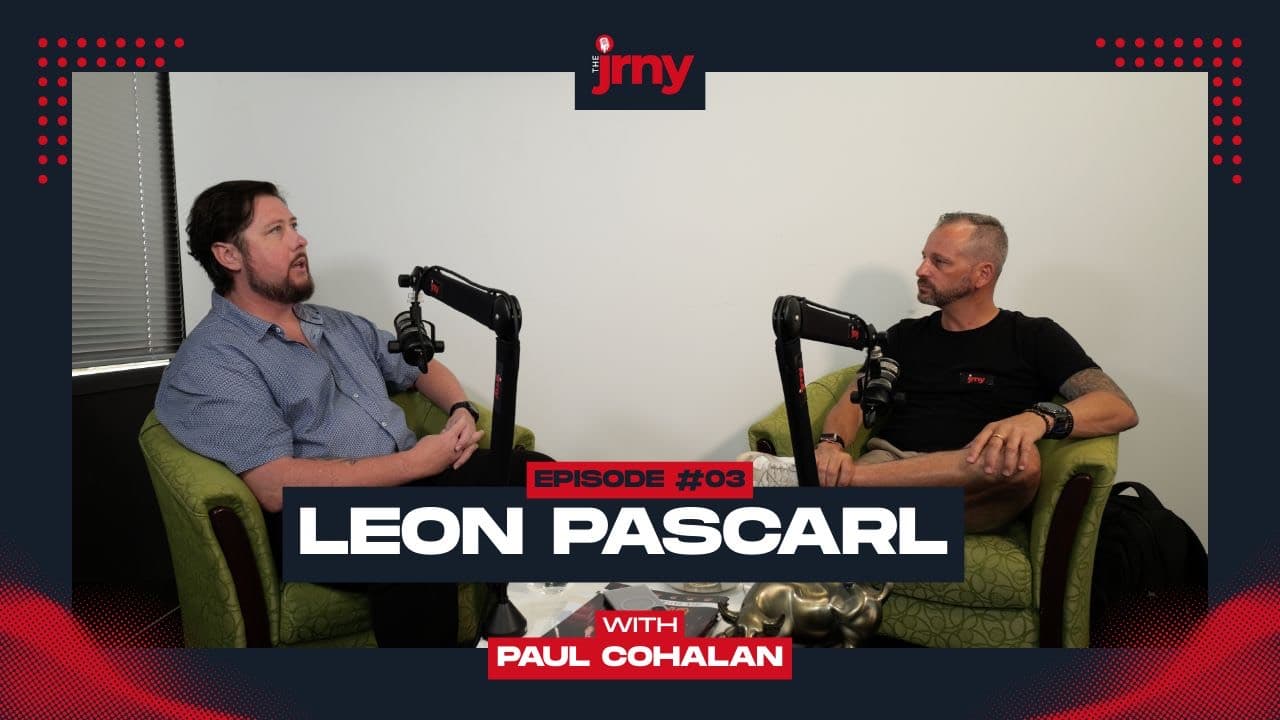
Draft summary and takeaways, pending Paul and Ben approval.
Meet Leon Pascarl
Business partner and operator
Leon Pascarl started young, from a butcher's counter at fourteen to store management, before mastering a new field through obsessive learning and stepping into a business partner role suited to the unconventional skills life handed him. He is candid about self judgment, imposter syndrome and learning to treat mistakes as data.
Episode summary
In episode 3 of The JRNY podcast, Paul Cohalan sits down with Leon Pascarl to unpack what roadblocks really look like when they are internal: self judgment, imposter syndrome and the pressure to be perfect before you even start. Leon traces his path from early customer service lessons and tough relocations to mastering a new field through obsessive learning, then making the jump into a role built for the unconventional skills life hands you.
They talk timing, pivots and why mistakes are data, not verdicts. The through line is simple and hard: reflect honestly, use the right people to sense check your decisions, and turn doubt into a competitive advantage rather than a brake.
Key takeaways
The hardest roadblocks are internal. Self judgment, imposter syndrome and perfectionism stop more people than any external obstacle.
Mistakes are data. Treat a wrong call as information to learn from, not a verdict on your worth.
Sense check with the right people. Honest reflection plus a few trusted voices beats trying to judge your own decisions alone.
Turn doubt into an edge. The weird skills and hard lessons life hands you can become your competitive advantage.
Transcript
Read the transcript
This transcript was generated automatically and lightly edited for readability. It may contain minor errors, and speaker labels are not yet added.
It's like a business plan, right? It's a guide because the market drives everything. Your life drives everything. Your personal business plan is useless if you put the idea on the page and put it in the drawer.
Y like it's not about what you're stuck on the page. It is about the the nitpicking on it and going, "Well, well, can I fix something?" It is going, "Well, that really worked." What's the most expensive thing in our world right now? Time. So, it's time to get it and it's space.
You know, and you're also relying on people filing things correctly. So, and I I I promise you, I've taken two, three years to do this. So, I and I can talk and I love doing this but this I struggled with until now. And I I promise you, you will get to a point.
You won't worry about any of this cuz we haven't got it like you might have some lights, but we haven't got it all over you. I've had a couple of clients in here that there's no way in the world I thought they would have. Actually, that was my second, wasn't they? Adrian and his wife and they just let go.
Never. And he's like I'm like so what's your what's your you know what's your roadblocks been over the years? He's been a builder since 0708. His dad passed.
He was started building with his dad. There was all this and I knew this cuz we're really close mates and he's a client and he's like I haven't had too many roadblocks and then like by the end he's like going back over his journey and I I was like pulling it back to certain sections. Yeah. And then at the end man he rang me after and he's like I am pumped.
I'm going to the office. Didn't he? I was sitting in your office. He's like, "Man, me man me free to love that." Like, they forgot all about this.
And his wife was probably more standoffish than he was, but they both like got a lot out of it cuz you go back over your piece. So, I'm not hitting a niche. I'm not hitting tradies. I'm not hitting insurance.
I'm not It's the journey, risk, roadblocks, and resilience. Y and it's and it's all about um you know, all your roadblocks through life. We can have all the winds high, but you don't really grow out of that. And me and you talk about this a lot.
This is why I knew you that's why every time I talk about this stuff, I knew you'd be good at this. I said this to Mitch because you actually you don't talk about it a lot, but if I bring something up, you've like, "Hey, I done work on that or I remember the you know what I mean?" So, I just I knew this will go well and everything that I've been through the last two years, you've been very supportive as well and you relate to a lot of it. So, I'm like going to be wicked. Uh you've been in the insurance industry a lot longer than me.
Um you've taught me a lot. I think I've brought a lot to the table. I think we bounce off each other well and probably out of most people in your role, you've been really proactive on the comms. You you know what brokers want basically, right?
And from an underwriting point, not isn't that 101? Know your customer like just just get on the other side kind of and and a little bit get in their head, but understand what their needs are. Understand what their drivers are, what motivates them, and if you can deliver some of that or provide a solution. Yeah.
Exactly. What I'll do, what what we're going to do is if I can get this real working. So, hey, where's that script? I just want to read this script.
I'm going to I'm going to read it to the camera, even though in the future I shouldn't because I can't remember it word for word, but this is just to give you perspective. I think I sent it to you, didn't I? Um, I got your synopsis. Yeah, that's what you mean.
Yeah. Yeah. So, I just want to go back to it. I actually want to read it out because So, welcome to the journey.
Risk, roadblocks, and resilience. A space built on simple truth. Everyone us, every one of us carries chapters, personal, business, and everything in between. Some chapters are messy, some are triumph, and some reshape us in the ways we never expected.
But together, they form the story of who we are and who we're becoming. The podcast digs into the pivotal moments, the risks you took, the roadblocks you hit, and the re resilience those experience forged. Because success was never meant to be a destination. It's a journey.
Your journey, our journey. This is a journey. Let's turn the page. And something So, I I really love that.
And we've redone that a few times, but I'm just going to leave it as that if it evolves. But the reason it resonates with me is because I've always said there's no finish line. I think I had it on my Insta for a very long time. It's probably still there.
And it's like there is no finish line. Enjoy the process. Enjoy the journey. It's rare uh from my experience that the goal you have in your mind that you set out to is the goal you finish with.
So, so to your point, there's no finish line. Uh somewhere along the way that got changed. uh somewhere along the way you went actually I I didn't like that. I want to build on that and and grow further.
Or I went that's really and you've done a full 180 on your pivot and you went actually no and I think you learn the greatest things in life just by doing things wrong. Um you know um understanding a challenge and understanding how to get over it and get through it is where you learn your lessons. So exactly what you just said there is a wicked combo because it's like a business plan, right? It's a guide.
Yeah. Because the market drives everything. Your life drives everything. Your personal business plan is useless if you put the idea on the page and put it in the drawer.
Y like it's not about what you're stuck on the page. It is about the micro tweaks. It is about the the nitpicking on it and going well well can I fix something? It is going well that really worked.
Can we dial it up a little that like what's the weakest link? And it might be that you're looking at it a hundred times and you're like, you're starting to do those things. Why do you grow? Because you're two weeks into your business plan and you hit a roadblock and then you got to go, do I pivot because they don't want to buy that pen?
Or the market says it's got to be a red pen, not a blue pen. So, do you stick your head up your ass and go, but I read a business plan for two years even I only just started the business because that's what happens right in the beginning. Or do I follow the market, pivot and grow and learn and go, "Hey, that's better because do you know what I mean?" 100%. And you see some people hit that first roadblock or a particularly big one and you you see that bit of a breakdown.
I just want to go around a corner. Um I get it. I feel it. Been there.
Look, do it. Go hard for a little bit, but know that that's very temporary. Pick yourself up on and and okay, well, I can go over it. I go through it.
I go around it. I could ignore it and go that way. There's there's hundred different that are roadblocks temporary. What is something we might talk about because you've been a big part of me growing last few years when you joined CBN in a different world like every state manager had a regional business partner part of our group is everyone's different.
So to get out of that bit that you just talked about go around and over it through it is what you do need and and don't you shouldn't be like this closed in. use the help you got around you, the environment, and and you are who you hang around as well and you spend time with and to help help you make that right decision cuz there's no right or wrong. You can probably do any of them and you're never going to know what the other way is. I I think it's much easier to identify the wrong decisions.
Um but what's right can be right for one person and not right for another. Um and it's flexible. There's no one right answer that there could be 20 different ways to do something. It's what fits for you.
Correct. And it can be what fits for you at the time. And that's um this is something I was thinking about just just last week and it was probably off the back of one of the the chats we'd had. Something can be the best choice and the best thing and the best decision at that time, but a year later like you you can have parked that and gone that's perfect and put it out of your mind.
But relook at it because you grow as an individual. Timing is everything. Um you know time is important in money as in that you know where it deployment growth in your business. So just go going on that there timing of stuff like what you just said like and I've done it I've wasted time money and everything on heaps of things but then some of the things are actually happening now or they might happen like we might have a plan for this year that I've been trying to like even this I've been trying to do this for 2 three years but timing is everything right cuz you got to be in the right mindset everything around you's got to go I've got to learn to slow down and focus more and delete delete delete add back in you know what I mean just on that though um I'm I'm trying to be vulnerable as I can in these Uh, and like these obviously in the these are the first few podcasts, right?
So, instead of trying to prep this all perfect, I'm actually going to say I haven't got shirts made yet. And while we're on here, this is going to be my makeshift journey shirt. Where do I put it, Mitch? Left your heart there.
Right there. The red on the heart. All right. So, cool.
All right. So, there's my Journey shirt and branding. I think Nat's got him getting ordered. Early days.
I'm going to look back on this in 5 years ago. Remember when I put a sticker on my shirt? Yeah. And it was like, go back to putting the sticker on your shirt.
I might still be doing it. Can you order me like a thousand stickers? I just needed the honest and raw. And every time someone walked in, I made him place a sticker.
All right. So, what I want to do is probably intro you a little bit. I'm going to jump on your LinkedIn here. I know that you're with CU underwriting.
I know your cousin, John Elliot. I actually don't mind mentioning him because I wouldn't mind actually doing this with him one day cuz he's probably the leader in it in business insurance and being outside the box and doing the personal thing. Right. So, family plug done.
Yeah, family plug done. And and you know what is it's actually really cool as much as you know we're competitors and all that stuff. We've always tried to catch up. Uh I really respect all all the brokers in the industry.
And then on that I I really love the industry uh for that kind of friendly rivalry. I've always said you know the fact that our industry is full of events. It is full of that social element and business crossover that it feels like you're doing a family barbecue sometimes with family. Um whether they're blood or not blood.
Correct. You know, your biggest rival is also a friend. Um or or something like that. So I I think it's it's such a dynamic and you know fun competitive space to be in.
You need competitors is what makes you competitive. It makes you what grow. Um I that's the great thing about CBN actually. Like what I don't know how many brokers got I always say 35.
We got more than that now in WA or about 35. Oh, we got a few. Yeah, few more coming. Let's say let's say about there.
Yeah, we won't probably won't touch on that this one, but um say that I always say 30 to 35, right? That's all the number I remember. Now, I I've been pretty involved with a lot of the brokers probably more two years ago than now. I'm getting back into it.
But I love working with them even though we're competitors. And it's very rare that we actually see each other's clients cross over. And even if we do, we're like, "Hey man, one of your clients, are they a pain in the ass? Are they going to move if you lost a relationship or are they just quoting?
Because obviously I got a lot of integrity and loyalty, right? Big time. And you know, there's friends, which I actually want to bring friends on here. I'd love to get other brokers on this because friends has got a wicked um journey, you know, um there's Kirsten, there's uh Doug, you know, they're all got everyone's got a different journey and I've learned so much of them because a lot of these brokers have been doing a lot longer than me.
Like I'm coming up 10 years in March, right? And um I the relationships we got and bouncing off each other. I actually had Kirsten message me the other day and she's like incoming letter of appointment for builders warranty cuz we're one of two brokers that do it in the whole group and and she goes but don't touch nothing else. And I'm like you know K and I wouldn't do that.
So we always have a joke about it but the trust there is like exceptional. But we have um you know amazing extremely talented skilled people all over the place and it's uh you know selfishly from my perspective it's really enjoyable to to work with people that are doing very different niches. Uh it it adds a lot of variety to to my life, my day and you know it's the years go quick now and and like Kirsten's uh other half better half Kirsten I don't know if you like that or not but Brian he you know he comes from the internationals and I didn't know him that well but I always lean on him with the bigger stuff and he's always like man I'll just and even last year when I was going through a bit of a hard time and didn't know what I was going to do next and I went and chatted with him and he's like man anything you need help with like that there being a competitive comptor, but we're in the same group and we bend over backwards for each other and do whatever we can. Um, that's pretty cool.
And that what that does is you grab CBN and it actually gives a lot of value to CBN having these kind of people in it which is fantastic, right? And you get you get to see it from a different perspective because you're not broking. You're looking after all of us. You're the connection right between you know us the state and leadership training the management and you know the whole lot of CBN.
And I think uh it's a huge credit to CBN as well and all the brokers. Yeah. Yeah. All right.
Let's jump on you. Eh, you ready? Let's do it. All right.
So, hang on real quick. I promise to chuck the disclaimer in. So, obviously, you know, do the the disclaimer gig, but we have to um you know, as much as much as we talk about CBN, and that's how we know each other. We we met, you know, near on 10 years ago through through the industry and we've worked much closer together for the last three.
Obviously, it's it's great to be here. We've had some wonderful chats, but uh all the thoughts and all the opinions and all the things I say today, disclaimer voice, you see, um are obviously mine and not the companies. Um and and that said, look, you know, we've got those skilled people, dynamic and really genuinely kind of sharing and caring people. So, yep, you can't really say anything wrong.
So, if you accidentally say something you're not meant to, just tell us to cut it. We probably won't cut it. We'll probably ask for forgiveness after, but just just uh let Mitch know because you know me, I usually say how it is and I do upset people sometimes. If you get me sacked, uh it's only going to deficit you.
Do you want a job? All right. He doesn't want a job. Wants to stay in the corporate world.
He's in his comfort zone. I enjoy the one I've got, mate. No, I know you do, man. We talk about that a bit, actually, so it's good.
Um and that was a joke, Sian. Uh, all right. So, CBN, uh, you've been with them 3 years in a bit. Before that, uh, oh, you're you're part of the achievers club.
I don't I don't know about that. So, we'll talk about that actually. Okay, cool. That's really cool.
Um, before that, CHU, I think that's where I met you originally. You were with CHU um doing the Strata property insurance. Um, you can tell us a bit about that in a minute. Before that, and this is from one and your last two, three years chat.
I didn't realize you were cousin with John, blah blah blah, but you're helping kick off the trady thing in the beginning. I think you're in the garage. I think there's a little bit there. I I could be wrong.
Right. Look, many many a thought and business thought. Uh and it's it's funny about insurance. Uh and you know, all all those ideas come usually with a drink in hand.
Yep. Um and later into the evening. And look, I I find that's a polite way of saying it. It it really is, you know, dabble through.
But I I think that's the same with anything. I don't think that's unique to this industry. I think maybe you see it a bit more or the opportunities a bit more and you've got to kind of curve it. But ideas come to you in the shower.
Ideas come to you when you're driving. Um ideas pop up at the the weirdest times. It's how you collaborate and what you do with them later. Um and you know, I was living with John for for a little bit.
Um as you know, he grew and developed his business further. So uh you know the amount of uh crossover business and um social things uh that was constant. Yep. Um and and extremely important to at the beginning especially well yeah at the beginning especially always throughout you probably need to to check yourself a few times and and you know self th those moments or that balance um because it's important for business.
It's great for inspiration and ideas, but you can get lost in it or you can, you know, push into things too hard. So, can I just touch on the whole I I will jump in here and here because obviously there's a time thing, but I really I really hit some nuggets and and obviously we know each other, but I'm going to have a question and then I'm going to drop a hint of what I think it is. So, the question is what have what did you get out of working with John early days when you were banging head? Hang on, let me finish banging heads and you know strategizing and all that stuff.
Obviously different people and you gone on different paths but there would have been some nuggets from there and and something you're very good at now is when I throw a problem at you or hey can we find a solution uh you're pretty proactive on it 100%. Um and you know a lot would be to you know confidential to his business and of course and and my uncle and you know the relationship you know John has with his dad and and what they bounce around you know that's there's so much value there. So um I think where you've got people around you that you trust and bouncing an idea around uh it can only enrich it. Y um I think with early days in business also when you're kicking off or ideas are coming and then you're like it we're going to do it.
what what I learned and I think one of my biggest strengths was learning small business family business and then going to corporate and mixing it and you've actually done very similar right and I think I found the balance and that's what I mean early days cuz when we we'll go along your journey early days you learn that make it happen find the resource like make it happen like there's no there's no like winging or can't do this it's like when you're in that hungry stage look there there's plenty of winging and there's plenty of can't do this but you almost need to put on your um and and go look, you know, it's it's do or don't. You've really got to to pull things down to to pick yourself up and just do it. Um and then you find you thank yourself for it later. And to to your question or or you snuck in there um and go back a little, the big thing I learned uh when I I jumped in and I worked with John was what the insurance industry was about.
It was that pulling the curtain back. Uh so quite honestly I still saw the the broker gig as that sleazy car salesman thing. I did when I first seen it as well and I I didn't want a part of it. Y uh and and working in doing some temp work and getting to see that in overwhelming amount of cases you were genuinely trying to help someone.
You were genuinely trying to support them. You are providing them advice or or kind of ideas around stuff that is completely foreign to them. So it is that level of of customer service explanation and so did it prove you wrong or did you tr or it could be a mix of this. Did you prove it wrong or did you try and shift and change the stereotype?
Look, it added uh that the stereotype's there for a reason and but it showed me that that isn't the norm and and it showed me that there is so much more to it. Uh and that that that is you know the majority. So, so just on that I started what 10 years ago when I come in the industry I remember writing this down I could probably find it somewhere and my biggest piece was even when I started with business partner 2016 it was like imagine changing the industry cuz I come from a totally different industry operations hands-on and then corporate and I'm like imagine changing the industry because it was old school still printing off bits of paper tick and flick no transparency no tech and it's cuz what I worked out in the industry's defense is they're big beasts you QBS your CG you all the systems, you can't just shift with the world that quickly. Very big, expensive, slow wheels to turn.
And and it's funny you should say that cuz that is one of my pivotal memories. Y uh so I'd come from retail hospitality. Um I I had worked as a kind of multi- you know, store manager and and um you know, I was I was looking at the the ordering. So you'd be on a tablet or or you'd be doing this stuff and you could pull up a report that was was basically live.
you could really kind of drill into to the marketing or or the what next and the style of entry. So, this is kind of what I'm used to on a, you know, day-to-day really quick, really agile. And and when I did and and I landed a job in the brokerage, so it was it was piles of paper and June 30, you know, right up to your shoulder on desks and that manic rash, literally paper. But that wasn't the shock.
Uh it was when I I did moved to to CHU and I first started and it was compact. So I'd never seen a compactus before, let alone uh rows and rows in a room that was buckling the floor. And the idea that you you pick up the phone, you've got someone there and you're like, "No worries. I'll just get your file and you're looking." And for those that don't know, a compactus is is basically a really big bookshelf on wheels and it's it's multiple of them that squeeze in together.
So you you slide these wheels along, you look for what you want, and you slide the wheels back so that they can stack more cases. And just on that, what's the most expensive thing in our world right now? Time. So it's time to get it, and it's space.
Oh, look, that's you know, and you're also relying on people filing things correctly. So, good time. Um, you you if you found the file and it wasn't on somebody's desk, um, and it was filed correctly and it hadn't all these variables slightly sideways because spelling or or or numbers got a little hard, then you had to hope there was something in the file. hell.
So, it was all it was all um against you. Well, yeah. Look, 100%. You you've you've got someone on hold on the phone or you said you call them back.
You've spent 20 minutes looking for a file. you finally find it and in there is is their last renewal. How's the industry changed now? And I'm like, well, I'd love some file notes.
I'd love some something else to go with it. Y um and I jokingly said to to someone just last week, uh I I do remember that feeling and you know, you're speaking to a customer and they're assuming you know everything about them as the insurer. And yeah, look, I have no doubt. We've asked you this question before, but you don't understand.
and I'm looking at a blinking blinking cursor on a screen and there's not a damn thing here. So, you know, I please just forward me something and let's work through this together. That's where me and you are a bit similar. I I love that story actually.
Like, let's count on the abusers kind of thing. But it last 10 years has probably been the biggest shift with tech and processes and workflows in insurance. And I know me personally it has been as well. I've always tried to like improve and I spent a lot of time and money and probably wasted a lot.
But I reckon I' I've got to a certain benchmark. But it but it's not obviously it's not just me. I think everyone with the socials and the world being so transparent. Everyone trying to improve business and we've got it.
It's a fast-paced world. I think our generation is the biggest generation shift from analog to digital in any aspect. Personal business, insurance, mining, you name it, any industry. Um I think we're lucky that we're in this shift because our kids aren't in it and our generation before aren't in it.
Really, we're it right now. Um, you know, I I still winge day weeks some weeks about tech and how old school, but then you go get a story from like you and you've been in the game a lot longer than me, the insurance industry, and it's like we've come a long way in 10 years, right? It's a very it's a very it's a great industry. I think we've got rid of the car salesman stereotype, right?
I think we've gained more value in the industry, you know, and that comes back to the way we do stuff, the way we approach the people skills, the way the way we do compliance now, and also the way we charge as well. You know, there's a lot of discussion around commission fees and all that. And um it's about valuing oursel, right? And and the way the direct market's changing in insurance like I don't know any of this here if you want to touch on, go for it, man, because look, I think it's it's about expressing ourselves.
And I think there's more to come. And to your point, uh, what's happened in the last 10 years in the industry, uh, is is a lot. Uh, and I and I love the challenge of a journey. Um, I still think it's behind the times when you compare it to another industry, particularly where it was, but but imagine where it'll be in the next 10.
Um, I'm excited for the road map moving forward. Every year I say this, right? It gets better and better because when you're in an industry that has so much opportunity for growth or evolution or tech or improvement, the great thing about that, it can't go backwards. Well, so you're there for the road map.
I'm there for what's not on the map. I'm there for that challenge no one's thought of yet. Yep. And and fixing that.
Um, so I you like the map, I like the block. Yep. So, so where your roadblocks there and someone's going, "Well, that's unbreakable." I'm like, "Oh, bet." Okay. All right.
Now you've brought that up, right? So we hit roadblocks, we take the risk and we build the resilience, right? This is what this podcast is all about and everyone's got it whether it's personal, business, you know, the career, it could be anything, right? Or in the future.
Now you you just mentioned roadblock like you so you're with with Elliot, you kicked off all that kind of stuff and then 10 years ago, a bit over 10, you joined CHU. So between um working with John at the beginning and him going on his path and you going on yours and go I don't want to broke anymore at the moment your mindset you jump over CHU obviously learn a different world you go to the underwriting thing about strata when I got in there and look for is that your roadblock? Well uh look most my roadblocks are myself um but I'm also my own best friend when it comes to it. Yesterday Lehon's a godsend.
Every now and then you dust something off out of the drawer and like that's written really well and I forgot I did that. we can use that timing. Um, so when I first landed that job, um, you know, and and underwriting there, I didn't know anything about strata. Um, I saw all these people and I was I was suit uh and tie every day to to work and and they were uh uh same or some some suit and tie, some, you know, it started this shift 10 years ago, didn't it?
Um, it look it did, but for for me, I'm looking around, I'm like, these guys, you know, know it inside and out. they've been doing it much longer than me. So, there was that whole imposter syndrome. Plus, I was I was asking for feedback and I'm like, is this good enough?
Should I be putting more through? Should should I know more? And I really wasn't getting anything at that time. So, you mean you mean feedback from others or yourself or getting team leader, manager, like you know, am I I was looking for that, you know, validation.
Well, yeah. Just just to know that I'm not you know, like am am I doing what you're expected to? and I wasn't getting anything from it. I keep forgetting how old I am.
Uh about 30 early 30s. Yep. Nice. Um and because I didn't get that, I then took it on myself to make sure I was ticking all the boxes.
Um so I took the Strata titles act home, the PDS, and and everything else I could find. And I read them cover to cover, uh front to back twice, and stuff just stays in my memory. Um so so for me I understood the the policy I understood the competitor's policies very well from there and as far as the legislation uh I'd actually read the 85 act what I hadn't read is the amendments the the 92 amendments that came out later. Um so I didn't realize this until like 6 months later and and I'm like oh crap.
So I went and actually read the current version of the act which redacted half the stuff that I' I'd just put to memory. But then 7 months in to having freaked out am I good enough to later I understood the last 30 years of the legislation because I read it and then read what they had changed in in the '9s. Y and you could feel this whole evol evolution of of what was happening where the industry had gone and trended. Yep.
And then I started looking at that in more detail and taking on extra things and then looking at how that differed across other states. Um, so look, my my freaking out going maybe I'm not good enough. Oh, look. Yeah.
And we've all got it. We've all got that voice in our head. We just spoke about this. If I hadn't have done that, I wouldn't have done the things I did to then become the guy you call.
Okay, there you go. there's another. So, it's uh it's easy to self-reflect now, but when you're in your 20s and start of your 30s and depending what you know what you're talking about if you're starting a new skill or experience and we tal we talked actually it wasn't last night, it was this morning in our morning chat. I was on a walk at about 6:30 and I was me and Mitch were on for about half an hour.
Um and and probably one of the biggest topics was that self judgment. This guy's on podcast and and on content all the time and really he started talking to me and I called him out actually. I'm like, "No, man. And I reckon that was your own self judgment there.
And I see him as like the, you know, the media guy that all that, but um we we've all got it like you just said, right? We're our own worst critics way more than we're our own advocate. The moment you pull that out of your head and and it comes back, it depends because when you're fresh at something again, that's usually when it's there, the judgment. But if you can get rid of it and be conscious and intentional and go, I'm only that's me stopping me, no one else.
You get rid of it and it just like takes the weight off your shoulders. I don't think you need to get rid of it, but you need to understand it. It's healthy to have a bit of both. Put it to the side at the time.
Well, just know it for what it is. Yeah. Yeah. Good.
Good point. It's okay to be nervous. Uh, thanks for making podcast cherry. This is the first time I've done this.
There's cameras. There's lights. Um, you know, just it shouldn't stop you from doing it. Yeah.
Um, but acknowledge that, hey, you know, maybe maybe that's you, you don't expect to be able to do something perfect. Popped his cherry. Uh, thanks. It was emotional.
You know, like you can't be an expert at something that you haven't done before. And there's always going to be a first time for doing something. Yep. And you're going to make mistakes.
Know that. Yep. Own it. But it's what you do with that.
And you know, and that the whole boxing thing or you always, you know, it's how many times you get up or or whatever analogy you want to have. You've just got to understand that mistakes will happen. They're not necessarily a bad thing. That's where you learn.
tweak it and try again. Yep. Give us um give us So you with CHU 10 years um you obviously learned a lot there. It was probably your biggest block in the industry I'm guessing at the moment, right?
Um maybe in the years to come. You've probably been might have been with CBN longer, but at one place it would have been a big learning curve for for you. Um you would have been a lot different from when you started to when you end. So probably in that 10 years give it is there and you don't have to obviously but is there a roadblock or a big risk you took personally in that journey or even outside it actually to be honest what comes to mind?
Oh look look look plenty um and that the the career before that was another 10 year plus. Um so I've done a couple of those. I I've never taken my long service leave. I've earned it in two jobs now and had it sitting there and then then been paid out as I switched jobs.
So, yep. Maybe the next one I'll actually take my long service leave. Um, but like heaps you evolve as a person, as a journey. Um, you know, there was was definitely hard times and you know, there there was a lot that happened in that business and that evolved as I was in it.
There was heaps that happened personally as well. you know, you go through different relationships, you move house, you you you know, I you go through people dying around you and and and those kind of things. So, one thing I do know about you is and actually when I uh separated with my wife, I think you around similar time, separated with a partner at the time. You don't have to touch on this too much, but um so we had a bit in common then.
I think we chatted about it. It wasn't exact, but I know I was going through my and you similar you asked about it and then you were like, "Fuck, you know, I'm going through the same thing and and really I think what was similar is it just wasn't working and we we actually had a chat about this and it was like you kind of know it might be coming so it's on the cards and then you you're trying to make the best decision for them and yourself in the end, you know, and there's always other stuff to it under the surface." But that was a really good chat I um I remember having with you. But go back something I don't know. Where were you born and where'd you grow up?
Okay. Uh born here in Perth. I grew up in Scarra. Oh, you did grow up in Scarra.
So Okay. That was my backyard for a while in Scarra. Definitely my backyard for for a while. So So grew up there.
How long for when did you move from Scar and where'd you go to? Kind of danced around a little bit. So you know, Scarra Inoloo, Belcata, Chewill, they're all in my backyard. Kind of I was City Beach for a little bit.
Um and then you know kind of further went further north. I was Calguli for a while. How long did you go to Cal for? Uh near on five years.
So I was five years running liquor stores there. I I'd said no several times to going there. Um and eventually I'm like yeah okay. And then then I'd said yeah I'll go for for two years.
Uh two years became three, two years became four and then I'm like I've got to go. So tell me, so tell me this is really cool because usually Calguli what I resonate with is you know mining transport and all that kind of stuff right diggers and dealers and gold bar and you know what whatever else but um but going you went and managed liquor stores what was your biggest challenge and what was your biggest learning and win there 5 years you it would have had a roller coaster there a bit um but it would have built a lot of resilience in you in a different aspect you're not in the city you know you g you grew up in Scarra it's a big difference Well, I mean, yeah, look, the first six months was hard um cuz it was relocation package. Didn't know anyone there. So, you got your you know, house car you sent there and you kind of sent to clean it up.
Um so, it was uh you know, basically having to get in there, you know, fix fix up a place, a lot of staff turnover, so you you're moving people on uh rehiring and you know that. How many people were at the liquor store? Uh oh, there was there was a few, but it basically had to to get in there clean slate and and do that and you know in a new town or in moving or or leaving your kind of friend groups that's that's hard anyhow and you know cowl and and wind back the clock and brutal. Oh absolutely because you've just left your friends and your environment and all your support that you grew up with and then you're like I'm on my own.
But what did that do for you? What was the outcome of that? would have built you. Look, I'd learned resilience long before that.
Um, but it just keeps reminding you. So, you know, being lonely or or or being challenged uh is just something you need to to work through and and sometimes that means, you know, find new friends, go out there, go do what you do, uh work on and it it can be, you know, particularly something like that. It's your personal brand, it's, you know, your reputation. What what are you you putting what are you doing about it?
So you're like, "Oh, I want this. I don't have that." Cool. You can all you like, but but what are you going to do about that? And so your social skills would have evolved because they're different dynamics, different kind of people.
Um would you believe I'm an introvert? I just been doing sales for a really long time. So didn't say it's comfortable, but you get there through it. you know, whether it's really I probably do believe that actually like you probably you definitely fine when you're comfortable and you meet and you when you know someone but it probably wouldn't surprise me a bit but so what what was the big shift for you when you started to like maybe go it I'm just going to talk more or intro myself more or where was you don't give yourself a choice I mean look I remember as a as a kid so dad had a butcher store so uh as a kid and we're still talking primary high school age and particularly Saturdays.
He he would have left god knows what in the morning uh to open up the shop and start prep and everything. I think I was getting up at 5 6. I was riding my bike from Scarra to Swanornne. Um Wow.
And then then you'd work a Saturday uh with him. So you kind of clean up boy, you're marketing, you're your whatever. Yep. Um and that that had a a customer service element to it at serving customers.
Yeah. Cool. You can be uncomfortable, but go ask that guy what what he wants. I don't know.
I don't don't tell the tax department it was absolutely illegal in child labor. Um, so you learn I was still in primary school. How how cool is that? So this is this is the whole point of the journey, right?
Is like until you sit here and have the convo and go back and reflect over everything way back then even like we know it does, but we just take it for granted. But you you're highlighting a single point. I I worked at a butchers from when I was 14, nine months till about 16, right? They are the maddesting industry.
Probably changed a bit now. They're mad as cut snakes, especially out the back. Now, you want to learn how to interact and socialize. I think now you said, I've never thought about this.
They are not a good example of how to interact and socialize. No, no, but but talk about open you up and uh build resilience. Butchers back then 20 years. Unbelievable.
Right. And I never really thought about that and it's probably a bit similar to me, but you're just talking about a piece when you went and worked for your dad. You got up early, you rode to Swanborn from Scarra and and you had no choice but you had to go your dad's like go and ask go and do this. So it started way back then, not just, you know, joining CHU and doing sales or of course.
Yeah. How cool. Like it's it's never about what someone sees right now. You you've had a life you've built and lots of little experiences that go into that.
And look, that's what I love about the job I do right now. Um, because if I had have gotten insurance earlier or something like, I wouldn't have half the skills I've got that I actually bring to this role. Y um so yeah, I I feel like I've picked up an eclectic bunch of different things, but just running businesses, different experiences, different hardships, uh usually and and and working through them, overcoming them or or you know, your way of thinking or or self-reflection or you know that that doubt moments and how many times have you you held the mirror up and looked in the mirror and uh do do a rebuild or or an an understand so that you you know what levers to pull and uh to that point business and yourself like take it apart, look at it, know what all the little bits are. Yeah.
Um because if you don't take that time to analyze it, um reflect, reflect and change, you know, you're changing things blindly or you're ignoring massive chunks and the dumpster fire of an elephant in the room. Yeah. You know, the one that everyone else can see, but you're like la. No.
Um, super important to to be raw enough with yourself and whether that's your business. Hold the mirror up, man. I or you personally get in there every day. Actually, I've always I don't know if I'll ever do it.
I've only just got the podcast, but I'd love to do a book, right? And and it comes back. It's over. It's the personal stuff.
It's the growth and and reflection and all that, right? And I I reckon there's a lot I got to give. And but the reason on the podcast is because other people got heaps to give, right? And I learned a lot from it.
But I always think of book names and the only one that really sits with me is hold a mirror up. Okay. Right. And no one knows that.
Not he doesn't very different place. Everything I think of has got a pun and it's probably horribly inappropriate and I like that. It made the best name. That's cool.
That's cool. I like it. But we're all different, right? And um and and what that's what makes the world go round now.
And that's what will resonate with this podcast. You know, we're going to be make sure we're consistent. That's why this guy's kicking ass to get enough under the belt before we launch on 1st of Feb. The reel I just put up, dude.
I I lock the date in. So, you actually don't have choice now. And either do I. Um, someone said to me before one day and and it's really cool is like if you go look at a car park, what do you see?
Probably cars and Benjamin. Yeah. What color are the cars in my mind? No.
When you look out of the car park, what color are they? Well, they can be mixed. Okay. What kind of cars?
Little bit of everything. Okay. That's what makes the world go around, right? There's diversity in your car park, is there?
In every car park, right? Go to a shopping center. Yes. They might be mostly Teslas these days or Camry, but um the the the point of the point of it is someone said to me one day, he's like, "Look out there at the car park.
We need every kind of different people." And that's when you start to realize that you like my two words is consistency from last year, but it's perception this year. I'm adding it on. Right. So, I got halfway through the consistency piece last year.
I didn't nail it and I'm okay with it. Actually, I was kicking my own ass at the end of last year, but it's like where I come from. I actually got 50% on the barrier that I visually see, but I wanted to add another word on for this year and it's per perception or perceived, right? Because when you understand that, it stops you being probably so blinkered.
And I don't think I'm that blinkered, but we all got a piece of it. Whether it's ego blinker or my way or highway or hey but this is my experience and I know this happens this way. Yeah. But the moment you go we're all different and no matter I might be right but you see it different.
My my life coach last year actually taught me this. I would disagree with your statement. You said we we need diversity in our customers in our clients. I I would argue you need diversity in your business.
I you it reminded me of um someone I worked with at CHU. Um, brilliant guy, really smart. And he he said, "Look, you know, if I hired nothing but Irish BS like like myself, I'd you know, have a great time. You know, we'd all be drinking beer, be a wonderful company, but it wouldn't be half the things it is because these people have different perspectives, different ways of life.
It is, you know, multiple different and sometimes competing and arguing and sometimes it's that comes out. It's like having a competitive program because you find a better way to do it." um you know well well we're both butdding heads and and maybe that's an impass then you find a third option um so if everyone was exactly the same and if everyone agreed with you you wouldn't be anywhere I said the world not business I said look at a car park we need all different people in the world whether it's people that want to be process workers or not everyone can be a manager not everyone can be a leader not everyone can be a fitter not like we we need that change and that's what I mean that's the analogy from the car part we're all different correct and because I believe everyone should be happy when they get out of bed in the morning. They should do what gets them out of bed in the morning. Now, what gets you out of bed, if you're not enjoying it, stop doing it.
Correct. 100%. And and the point I disagreed with with your clients is you want to understand all the different customers and all their diversity, but you don't need to be something for everyone. Yeah, correct.
Like know what you want to do, know what you're good at, know what you don't like doing. Yep. You know, and and if you don't like doing it, why are you chasing that for a client or a customer? Yeah.
Yeah. Yeah, that's great. And talk about the adversity bit and the challenge and the disagreement and me and you're good at this actually and this is why I love our relationship. Like if something goes wrong and I'm not happy, you know, I'll just ring you and go, Leon, what the is going on?
Like and and then you'll be go and you'll go, man, but I the first the first 30 No, no, no. The first 30 seconds are getting you off a ledge. Uh channeling your energy and calming you down enough to understand what the you're talking about and then we go into problem solving mode. But that you bang on, right?
you're good at. Me and you know each other well, right? So, we can probably say anything we want and it's never personal, right? It's like, but the the key to that, what I was saying is you still will not go, "Oh, okay, Paul, keep me happy because I'm one of your brokers." You'll be go, "Paul, the reason this happened is because of this.
I disagree with this, but I agree. I see where you're going with this." Now, that that there is Don't be afraid to say no. Correct. Sometimes it can't be done.
Don't break yourself trying to do something that's impossible. And usually I come back and challenge you still and go, "Man, I think it could be done." and then a week later I'll probably come to you with my tail between my legs and go Leon you're right it couldn't be done or vice versa and I think they're good traits by by people you know by humans in general right it's the whole game of tennis and look sometime sometimes we find a middle ground in there and like actually that's not possible but maybe this part is so let's take this a little bit explore it a bit further and go go back to perceptional perceive you see it different you're in a different role you see all the brokers I'm in my world so then when you bring reality to me and you're like Paul this is not going to work because we're talking structure recently right over a couple of things I won't go into but it's like you're like that can't work Paul but this can this is check where you've got trusted people around you and different trusted people around you and you can sense check something between them and they'll tell you yeah I don't care it works for me oh no that won't work for XY Z or that did you think about that and like no I never thought about that why would I think about that That's what enriches it. You know, that's that's where you've got a little more safety to to tweak that design before you, you know, your neck's on the line with it and you're throwing it out there halfass. Something I want to touch on uh risk.
So, you've no doubt had some roadblocks. If anything pops up any significant, let me know further than what you already have. But the the the risk I want to know when you went from CHU to CBN, and I actually remember talking to someone in our group about when they advertised the role and they said they're chatting to you. Um what what what was the risk and how much of a risk was it?
Was it easy? Was it hard? The jump. Because let let me let me expand on a little bit more.
This is one of the biggest things people struggle with in their career until they do it once or twice. They jump. They're too scared. But I think the days of being in the same job for 30 years are gone, right?
But you you tr you're kind of cultured and trained when you're young, you know, stability, security, and all that. But these days, I I believe go and try. 20s and 30s, go and try. Move on.
Ah, so the jump, how was it? Look, we'll get into the jump in a little bit, but but first I kind of want to take my uh tact on your statement there. So, I think there is absolutely still value in staying with a business uh long term. Yep.
Um you know, for for as long as you can, just not as common, but it is it's a two-way relationship. Uh do get out there and look around. Do do uh you know, just but doing things is the only way you're going to learn. Would you agree that it's not survival anymore, security?
It's com it's it's it's loyalty and staying there if it makes you happy. Yeah, correct. That's the difference. And and it's middle ground.
Um you know, you do see someone that'll jump around from a job every six months and that that still has a bad look. Red flag. Um, but balance, you know, if you're a couple of years in a role and you're you're taking something out of it and you're you're building on yourself or you've realized actually you've tried something and that wasn't for you and you've you've then, you know, taken a move or you found found something that's good for you, doesn't do it, build on yourself. Um, that's that's part of this industry.
It's really really everyone knows each other um as soon as you get out there and there's opportunities all around. Um, and it's it's about finding what's right for you, um, and a good fit business-wise. So, I'm going to back to the move I made. I wasn't I wasn't looking for a job.
I wasn't looking to move. Um the timing was really right because I was I was working on a few national projects and some other things and I'd just wrapped those um and some other bits and pieces and uh the clients I was working with and everything was was quite solid and smooth. So as much as you comfort zone though no I'm my own worst enemy for comfort zones. I overload myself, uh, freak out, work out how to make it more efficient, create a gap, and then make up a new project and jam it in there and and compete, you know, repeat that cycle.
Um, so yeah, I'm a bit of a dick. Um, but I'd done that and and I'd I'd stretch the role a lot, um, quite honestly, and and I was, you know, into marketing and compliance and different things that weren't typically that role. You're doing that to self-growth, right? Like you love learning new stuff.
you love trying to problem solve and all that kind of stuff like what you said earlier. Yeah. You know, it's my own worst enemy. It's not, hey, I get paid this five, I'm a minute, you know, it's a minute before knock like you're not that guy, right?
It's good for me. It's good for the company. Um, but where I'd moved like I I knew knew the company. I knew what was being asked.
It I I'd known it uh since it was the companies it was previously and for some time. So um and look in the back of my head um and they don't know this but it's it's somewhere I'd thought of working before like that had entered my head years before I hadn't done anything about it. Yeah. When it was Westcaugh and Yeah.
Yeah. Well even you know when it was Westcaugh or NAS or or even in its infancy like the I'd already looked at that business and knew it and go well actually in my head that that's somewhere. Well you had a bit of a journey back from Jeff. I I joined Westcourt originally um back in 17 2017 I think or end of 16 and um it's been they've had a wicked journey and they're the leaders in the industry when you want to talk vehicle group AR network and um you know it wouldn't be silly that you thought about it before but timing is everything and things happen for a reason.
Well, yeah. Look, uh, I got quite the heads up that the role might become available and I'm talking, you know, more than 6 months and and I said, you know, still not looking, but maybe maybe ask me when it does. Uh, you know, happy to be considered. And it's just, you know, understanding what what I do on the daily.
It's just such a great fit for the weird stuff and skills I've collected along my life journey. Um, so is that more because of the different type of brokers or internal or a bit of both? No, most of it's got nothing to do with insurance. It's it's the skills I picked up, you know, doing ONS or risk or or the the level of HR or managing people and and different things or or the stuff I just learned running a business or or different businesses or or things in my life.
So, very little of it was insurance. And that that's why I said earlier if I'd got into insurance earlier and done XY Z sure you know God knows where I'd be but I also wouldn't have those other skills I brought to the table because I wouldn't have had that opportunity to learn them. So um yeah I I look I just saw it and I understood understood the role. I understood what I could do with it and I understood how uh I guess well that the synergy of of of what I've got would go to that.
So, yep. That's cool. And what was the transition like? How much notice you give the previous job, the new job, and then how long did it take you to really set in like was it a few months with CBN and the new role?
Um, so I look, I gave plenty of notice. Um, I I gave uh two months notice. Um, I think we ended up uh No, I think they were talking, oh, we'll let you go in a week. We'll do gardening leave.
And then I'm like, have you seen my calendar? And they're like, oh, okay, right. And we found somewhere in the middle and I think you end up working about 6 weeks out. Do you know what just on that right that's a credit right because when you go bigger companies they do go garden leave and everything and trust me 90% will do that right now the only time they don't is when you're a good person.
Look I just about leaving to a competitor. So I look I'm not a threat. You know I I was going to continue doing the work as needed. Uh it's it's you know my opinion even if you were they probably still would have because of your personality.
We just shake hands part ways. It's, you know, good innings and uh, you know, we're still absolutely working with each other tomorrow. That doesn't go away. You've just you're sitting in a different so close, didn't it?
So, so just so day one uh to that um, and you were there. Day one, I saw the CV the PD I was hosting one of our uh, PD days in the city. Yep. So, I'd walked in in a suit.
Uh, I was handed a polo, said swap shirts, all people, and get up on stage. Um, so the laptop had been posted to my house. Um, I hadn't done anything with it. I I didn't have the passwords to log in.
What was the date? Can you remember? Oh, god. No.
I'm not good. What year was it? Oh, three and a half years ago. Yeah.
So, whatever that was. Um, it would it would have been like the November one. So, it would have been the the back half of the year and it' be dying off, right? and and you know obviously that's changed but it was dying off this big shift in CBN it was all that stuff you come on board and um that day would have been a hard day for you especially the first day but it couldn't it only got better you know it's not like I didn't know anyone in the room um I think I knew everyone in the room get on stage host a day um what I found out later is uh when I I got the password to my laptop and unlocked it at about 9:30 that night with you know 150 unread emails uh one of them included the script for the day.
Oh, so you didn't have that. I I like, "Oh my god." Like I figured this is just how we do it. We wing it each time. But no, I had a full script.
The road blocking. You didn't even know about the road yet. I mean, sure could have put a better job in, but um you know, and was I nervous for for a little bit, but you know, you get over it quick. You just do it.
Y and and that was a you know, do I get a chance to have a practice run? Do No. God, no. Day one, get in there.
You start early in the morning. You This is the day. So, so just just touching on our previous conversation then and how important what you just said like that would have built resilience whether you probably think it did or not but going back to someone that's an introvert to being thrown in the deep end going along the journey CHU and then starting a new job and you're older you're in your 30s and you go and you're like you just you're thrown in on the day your email you can't your laptop you can't log in you haven't got your script you don't even know that that there was a script you're nervous you get up there you nail it you got all people there and it's not you you just started But you've taken the ownership of that. And I remember having the chat with you and um and look where you are three and a half years later and all them little 1enters.
I think we turned it around for the next one because the first one was, you know, we need double the amount of people in the room. Um but I was going to say to to your point there, yes. But get comfortable being uncomfortable. Yeah, 100%.
I think everyone says that these days, but it's really But know what that means. Yes. Like push yourself through. It doesn't mean give it time space and then or break yourself or just just Yeah.
Yeah. And don't don't break yourself, but but know it, understand it, be nervous, but get in there and do it anyway. Care, be nervous, have butterflies, all that stuff, right? Cuz really people actually appreciate that.
And when you think about it like that instead of, you know, half empty, half full, and go pe 99% of people won't get up and host a day for starters. They won't do it with no script and planning. and and then like people like when you're sitting in the crowd, people appreciate that you're up there giving it a go and if you look nervous, people actually are grateful and actually will support it will um and but take that on take that for next time and look you know you you'll get selfcon you know do I look right am I am I have I put on too much weight am I standing in front of people you know my hair looks like I just came from the gym this morning all those things are there and they're real but do it anyhow and then then go back and analyze it Right. Did it Did I just speak 100 miles a minute?
Stop. Breathe. Yeah. It's okay to pause.
It's okay to have silence. Yeah. Sometimes it's more impactful. Yeah.
Of course. Um though that little bit of analysis after, well, cool, you did it, but could you have done it better? Yeah. and and it's it's I guess it's a really hard and sometimes emotional place to critique yourself like that where you're not just picking on yourself but actually going well I did that and I could improve that and I could do that and be that level of constructive criticism you'd be for someone else but with yourself I I think you absolutely nailed it like we we talk about the resilience piece right so the the the little bit that goes into the formula of resilience and this is in my opinion right, is the don't care what people think.
Now, our mind is our most powerful and positive, but it's also our most powerful and negative thing, right? We can make us go down the rabbit hole, make us not do it, make us not get up on stage, make us But if you get the right mindset, now what helps that get better 1% of your time is throwing yourself in the deep end. The next time you do it, you're that little bit. You're like, I did it last time.
So, you got that little bit of history to go, it. I'm going to do it again. No one cared. And then and then you get the and I'm actually doing it now.
I'm getting messages and that from the content. Do you know how much that helps me now that I'm I'm doing it? And yeah, I got some mates going, "Hey, who you talking to? Who this?
Who that?" I'm like, "Whatever." But then the ones are like, "Man, you're yesterday morning. That was wicked. Keep going." You went and jumped up on stage, done all that. You know, everyone at the end of the day, you done an amazing job, right?
First day. Now, next time you do it, you're like, I remember talking about after I'm like double next time going to nail it. Like so every time you do that little bit of growth gets better and better and it's the for part of the formula to that resilience piece I believe. Yeah, it really is.
Um and you just got to do it. You got to just do it. Nike 100%. So cool.
So there's a couple of points I I want to talk about today and moving forward. So you're with CBN. Um I suppose I I know you do a fantastic job. You you really really connect all the brokers here and also uh nationally.
I know you put a um you you love working on projects like you said and stretching your job. Something that resonates with me and I really love and I've got a long-term relationship with now is the mentorship program that you know you work closely nationally with with CBN. Now this is the stuff that you personally are passionate about cuz I remember talking to you about it 100%. CBN are fantastic.
I'm backing this stuff and it was a really really positive outcome. I was on the first one with it. um the same broker now even though he's not with CBN I still have a great relationship with we still mentor each other I got I was a mentor he was a mentee but we it's both it's two ways it's not even it's not even here or here it's like it's like running workshops years ago you learn off the apprentice just as well as you do the qualified right it's it's absolutely two ways me and Harry and he's he's an absolute legend might even tag him in this um he's he he moved on but um we learn a lot of each other and it's a great relationship But it comes back to you wanting to create better brokers, bounce off each other 100%. Um, but I also saw a huge opportunity and and throw back to where I said, you know, where you've got support around you and you can trust them and bounce ideas around.
Uh, what I saw from my perspective is I saw some extremely knowledgeable and skilled people and a diverse bunch and in their own niche or in their own right. And I'm like, well, we're all friends here. Wouldn't it be wonderful if you know you could take away kind of any competitiveness and have that opportunity to share some of that stuff and get along or to our chats or or what we've had but we we all have different businesses but we all have the same problems sometimes at different scale. So everyone's experience resonates w with everyone else and and and for me it was no-brainer.
It was, you know, we've already got everything together. We've already got all these people. We've already got that. Well, why not just take that extra link and go, well, if I've got an expert in this, I've got an expert in that.
Um, you know, you want to know that. Well, it's just, hey guys, have a chat. And and out of out of that though, and it goes back to what you said earlier, a lot of the combo is not insurance. And it's my biggest thing.
I'm talking to the guys at the moment about just moving forward and hiring brokers. people skills in business is is probably over 50% insurance we got webinars we got we get drummed it right and like you learn by doing it right like most qualifications or experience and that that was one of the biggest piece and relationship and friendship out of it and we can bounce off each other um I used to have Harry ring me about fleets because he was with a finance company that asset finance and then like and then we started talking contractuals and business and business structure because they were the legups with the guys that he started quoting And he's like, "What extra value can I give?" I go, "Mate, contracts, w subregation, principles, indemnity, the fleet, the different kind of fleet structures, valuations." So, we started talking about all this not the policy. And it was unbelievable. And look, I think that's a really important way to to look at everything.
It's the what value can I bring, the what else. um cuz you've got why you made it to a room or why you're sitting in front of somebody having a conversation, but it's it's often the what else that you can run through and bring to the table that's the most value. Uh and then particularly if you take speaking insurance or clients in general, so many times you're faced with someone asking for something but that's not what they want. Yep.
um because they don't understand what they want or or they don't know or you haven't taken that journey with them yet and they're like I just need this or actually you don't you need this and this perspective correct and it's it's just taking that time to explore it and look on the the mentoring piece and if you don't mind I'll because you mentioned it before I will plug it um I'm also involved in a you know not for profofit a charity so I do want to know about this give us a couple minutes and then I've got two more things we'll wrap up but Yeah, far away. So, the the charity is Achievers Club. Um, it mentors uh low soioeconomic uh children that are falling behind in school and stuff like that. Um, so you get in there and you're coaching them with school work.
Uh, but it it is more the mentoring on on whatever else could be going on in their lives. Social, mental health, family, there's a heap. Um, wow. Oh, I didn't know that.
And everyone's different and Jesus, it fills your cup. Please tag us in this, right? There's really big I'm really big on charities and family and like kids especially, right? Because like in my 30s and 40s, I work more on my childhood stuff that got us where we are.
Y but it's like a lot of them don't have support and stuff like that. So, yeah, honestly, support and perspective. That's it. you you watch uh a kid, you know, and if you're mentoring someone and you're taking them on as a a new um you know, kind of relationship and you're forming it and you can see all the the bits that might be a struggle and it's it's not a massive breakthrough.
It is support. It is consistency and it's coming at something from a different perspective. So just quickly on that, what's it called? Achievers club WA.
Achievers Club. Yep. Yeah. Achievers is it WA or national?
Achievers Club WA. Okay. achievers club say give me your biggest challenge in the last year and a half with it uh recruitment for mentors that there's there's plug that's that's our biggest challenge uh sitting on the board um you know where there are so many kids that need help and there's it's been going for quite a while um you got three chapters so you got um Gerowine Armadale and Butler Yep. Um, yeah.
Look, our biggest challenge is there's so many kids out there that need help. Um, and we need more mentors. Um, so g give me, and I'm just trying to speed this up a little bit, just a couple of things. The other piece, give me the biggest heartfelt or win you've had in that time.
Uh, look, it's it's every time, but it it's where you see such a a massive turnaround. And I was uh mentoring a girl and uh, you know, initially the struggle really hard to to talk. I think there was, you know, bullying and other things going on. Um, but a huge turning point was when she actually wanted to to plan things together and there was there was some group stuff we we did where it did involve getting up, public speaking, setting, doing things uh primary school age.
Um, and so watching someone grow, get more confident, come out of their shell, and then say take an initiative and go, I actually want to plan and facilitate these things. Let's do it. That that is something else going to school and doing that. Um, so like just just seeing uh someone get it.
seeing seeing that the fact that you just switched it up and and tried from a different angle and they're like, "Well, that clicks and then seeing that personal growth." That that's that's a huge and I'm guessing they got the chips against them at times, right? Well, yeah. They're not there unless the chips are against them. Yeah.
So, okay. So, that's the point. I'm just trying to learn a bit about it. So, you want to talk about risk roadblocks and resilience like this is the best bit of our podcast to be honest.
This here really hits. You got primary school chips are against them. Now, what are they doing? Like some of them, you're allowing them to have that safe space to open up and to give something a crack.
Like we're talking before about jumping on stage not being planned older. You're talking about a primary school kid that goes, I want to plan and piece this together. Like that's amazing. Like it's it's a big jump and it's a big challenge, but what if someone reached out to you and gave you a safer version of of practice and trial?
yeah. Um and I I throw back to work. I love roleplay and it's not for the little bits of drama and stuff I've done, but everyone bs at it in in business or insurance. Oh, here's a role playing game.
And I'm like, lean into this. This is your safety place. You can be a dick. You can be a full and it's the people in your office.
And sure, you got the the politics or whatever there, but do you really want the mistake you're making to be with a live client? Yeah. like this this is your time to experiment with is that what helps the kids um understand really what happens because you don't know what you don't know right we say this all the time so role playing and going through a process or what the challenges are does that help them have a little bit confidence in the real world it can it's a tool um yep you know it's it's something that people shy away from because that oh that'll be embarrassing I'm like no this is how many people in the group when you're discussing and doing well this I'm talking about more broadly than the mentoring itself. Um, but look, yeah, there's there's huge amounts of students.
I think it's a couple hundred. Yeah. Wow, that's amazing, man. So, three divisions, Achievers Club WA.
So, uh, we we'll definitely do a little bit around that. That's that's awesome. And someone like yourself and I bet you get a lot out of that, right? It fills your cup plus% when you can put out your experience and journey.
Look, sometimes I think I'm getting more out of it. Don't tell kids. Um, but yeah, it's to to genuinely help people around you and particularly people that are struggling and and don't see a way out. Yep.
It's it's not a lot of an imposition for me and and particularly if you you feel like you there's a lot you see where you're like, I was there um in a variety of different ways. um you know, and whatever you've pushed through, I think you get to a point in your life where if you've pulled enough together and and you're actually feeling pretty good that that you made that journey, I think you've then got a responsibility to to look back on the path and see if there's anyone you can give a hand to. Yeah. All right.
Cool. So, that that was a wicked segment there. So, uh there's two more things. One, this is probably the main thing for yourself.
What's the 2026 chapter look like for Leon? I really want to know. You're always like you're always looking for new stuff. You're always problem solving or you got something in the pipeline.
I do. I'm just trying to think what I can talk about. Give us give us a nugget. Something we don't know.
Give us give us the surface of something. Uh look more extra. I think I think uh I've definitely got ideas. I've got different plans.
What does CBN approve for you or give us a little is there something? Absolutely nothing. Everything is confidential. Um, but I'm always working on something like you said.
So, there's definitely some things in the pipeline that there's definitely uh, you know, extra things that I think we can do with with our region and community. There's always something happening with the company. So, I I think to to give you that taste and you know what I can bring if I say more plus or you know more extra or same but more um, expect that. So, cool.
you know, we'll build from there. So, I know we'll talk about this after after the podcast, but give me just off the top off your gut the takeaways from today. Uh, look, I I really enjoyed it. Uh, I I did ignore the the camera and the the lights mostly and and I hope um God knows what I look like.
Look, I think we've we've had some great conversations along the way and and some of this touched into things we've talked about before and you know, it's that crossover between your business and your personal journey. Um, and huge amounts of resilience in that and huge amounts of understanding. Yep. Uh cuz we're all just human and we all start from somewhere and most of the time you're around in the dark until you work it out.
Y so that I think that's going to ring true forever and ring true with a lot of people. And then I really liked how much we jumped around like we cover a lot of different stuff today. It's really cool and I try and do that. Everyone says there needs to be a flow and there does but when I grab something and relate cuz you you won't see it.
I can see it. I'm like well that relates to when you were working for your dad as a butcher and you and you and you piece it together. you'll go away now and your life mind will be gone because you've just gone back over your book and all your chapters. Right now, one thing I want to do is um I want to check in 6 months later with most people that get on here if it works right around 6 months.
We've been talking about this. I want to get back on and it might be a shorter one. It might be not even in this setting, but it's like we're going to take from this and um go or could be 12 months, but we're going to do that in the future. So, just want to let you know.
The other thing is give me two people I should get on here. Ooh, CBN, nonCBN broker, non CB non-broker. Like I I think um look, really good question and I don't think I've got spit out immediate tag. I'm going to get on.
No. Um I feel like you're going to have to edit something back in. I guess look there's so many people and and look that that mentoring piece or or or community or um I I just saw as I walked in your building uh you know who you've got down on the corner there may maybe drag them in. He he loves a mic.
Who's that? Politics. Yeah. Yeah.
Yeah. So I I think No, I'm talking about people we know. We know we know bigger people. I anyone.
No, it doesn't have to be bigger because that's that's the whole point here, right? We're all human. It's all about where we're at. So in that case, like really really different.
I I don't have names to give. I'm also not like give me a broker. Give me a broker. No, I can't.
Um yeah, just name dropping and the the idea. I just I just can't. Um but I really don't think you can go too wrong. Yeah, cuz I everyone has a unique experience and it might just be uncovering it.
They don't know what they've got to bring to the table until you start kind of dusting it off a little actually. Yeah, I I did do that. It's like, well, no one else does. Yep.
Like, tell me more. Y So, I think it's it's just uncover maybe interview everyone. Yep. So, everyone.
So, so on that, the two I got out of this, and I never really thought about them before. One I did is Fran. Um, you know, we've got a really good relationship. We don't see each other much, but we always have the odd text or bounce off each other or whatnot.
I do really want to get Fran on. Um, and the other one that I've been want to catch up with and um, and I I'll probably hit him up soon and I'll probably text him before this goes out. We talked about him is John Elliot, which he's already doing podcast and all that stuff. So, uh, hopefully he'll jump on with us cuz he's got a different dynamics of the insurance industry.
So, um, I'll probably tag him out of this and text him directly. Um, but that I I would have already done that. Um, but man, thanks for jumping on. Uh, it'd be really good to check in in 6 months or you know, whatever works.
me and you obviously we got meetings once a month or whatever. Anyway, oh just just quickly the other thing that you really helped with and you continued why I kind of was in the background the last two years is the WA broker in business. I didn't touch on that. I had it in my head before.
Maybe we touch on it again short. Maybe we do a little 15inute on it a bit later so we don't you know we got to close this podcast out but um that wa broker and business I originally thought about that because I used to be part of the CEO institute and it goes back to what um you say about all the brokers and the mentorship is we all have the same problems now I think it's really really good that WA brokers in business even the WhatsApp chat and how much we bounce off each other I'm using it more lately I'm trying to get back in now to but one thing I learned last week week before when I jumped in in the CBN office is it'd be really good to at least every second month get everyone in person if we can because you just cannot beat being in person. I I think look being in person is great. Um and without getting into the the nitty-gritty of business, we we'd we'd talk together and and we'd seen an opportunity to to take something that existed and changed and and take it in a different direction and grow it.
Um I I think in person is extremely valuable, but we're also super time poor. So we just need everyone there and all those things, but we do need to keep uh you know and like we have with with guest speakers and different things keeping it uh real and and importantly bringing things of value to the table because because that's done the job. You know, we don't have to do anything else. We don't have to over complicate it.
Keep it simple. Um, and if you keep sense that and if you keep going, well, is this bringing value to to what we want as a group? And the answer is yes, or or the answer says, well, that is, but that's not. And you pivot and you keep evolving.
That's the job done. Just keep doing it. Keep asking that question and keep moving forward. Yep.
No. Awesome, mate. All right, let's wrap it up. No worries, man.
Thanks, man. Thanks, Awesome.